Sunday, November 15, 2009

Tour and Paella at La Espanola

Tour and Lunch at La Espanola

If you love Spanish food and are living in the LA area, then a trip to La Espanola, one of only four Spanish cured meat producers in the United States should definitely be on your to do list. La Espanola is an unassuming white building on a small side street in Harbor City in the South Bay part of LA County. To some who may hesitate because of the drive, let me tell you, it's more than worth it. I found that out after I made arrangements for my dining group to visit one Sunday for both a tour and lunch, but first, let's learn a little La Espanola history.

More ...

In 1982, La Espanola Meats was founded by Juana Gimeno Farone, a native from Spain and her husband, Frank Faraone. When the couple relocated to California, Juana was disappointed that the availability of Spanish cured meats was extremely limited to almost nonexistent. After a lot of effort, she managed to find a Spanish food purveyor in Harbor City. After the current owners decided to retire, Juana and her husband bought all the remaining inventory and decided to start their own company.

27 years later, La Espanola wears many hats. Not only do they import, distribute and sell, both retail and wholesale, Spanish foods, they also manufacture Spanish-style sausages and cured meats using traditional Spanish recipes. Along with cured meats, other products that La Espanola imports from Spain to re-sell here include olive oil, olives, canned foods, candy, paella pans and more. As for their plant, it has the approval of the US Department of Agriculture and has state-of-the-art equipment, including mixers, multiple curing rooms and ovens.

On the day of the our La Espanola visit, many of the group arrived early to check out the retail store and as luck would have it, the store was sampling quite a few of their products including cheeses, cured meats, white anchovies and olives. I have to say it was difficult to display restraint. The quality of the product really was evident in how good everything tasted. I enjoyed the spicing of the cured meats and I could have eaten two plates of the white anchovies.

Tour and Lunch at La Espanola

Walking around the small store was like a treasure hunt. It was just amazing the variety of products they had for sale. The various meats, sausages and cheeses were a definite draw, but so were the wines and the olive oils. Also on the shelves, I found sardines, quince, both an asparagus mousse and piquillo pepper mousse and so much more.

Tour and Lunch at La Espanola

Soon, it was time for the tour and it was led by Alex Motamedi, a family member and it started outside where he first told us La Espanola's history and we also got a chance to take a peek at the Paella that was going to served later in the afternoon.

Tour and Lunch at La Espanola

After the talk, we put on our oh-so-fashionable hair nets and were walked into the inner sanctum of their plant. As an importer of cured meats from Spain, those meats arrive whole, are cut into larger pieces, sliced, put into a plastic wrap, vacuum sealed and are ready for sale.

Tour and Lunch at La Espanola

The star attraction was really the sausages. First, Alex pointed out the various machines that go into the sausage making process from the grinder, the scale, the mixer and finally the sausage casing machine.

Tour and Lunch at La Espanola

Then we took a peek into sausage nirvana where row after row of sausages hung. The temperature, humidity and airflow in these curing rooms are carefully monitored. For a moment, we just stood there in awe. It was hard not to want to run in, grab a few sausages (some of which were actually taller than my 5'1" height) and make a run for it. It was a beautiful sight of meaty-goodness.

Tour and Lunch at La Espanola

Once the sausages have finished their curing process, they are taken out of the vaults to be cleaned and packaged. An interesting thing that Alex mentioned was regarding the white mold on the surface of the sausages. During this curing process, white mold grows on the outside while the moisture evaporates as the sausage dries; hence, you get a dry sausage. There's apparently nothing wrong with the mold and while La Espanola generally cleans it off before packaging the sausage, they do get requests for the mold to be kept on for those customers who want to ensure the sausage was actually cured on location.

Tour and Lunch at La Espanola

It was definitely a fun and informative tour and I always love going behind the scenes of a food factory because it makes you so much more appreciative of the work that goes into what lands on your plate. After the tour, we walked over to the covered patio for lunch which started with a tapas plate of cured meats, cheeses and olives.

Tour and Lunch at La Espanola

Soon it was paella time and it arrived in a large platter right in the middle of our table. This was definitely an epic serving of rice, sausages, mussels, shrimp and chicken. I wasn't even sure if we'd finish it, but I have to say we made a pretty good dent and along with espresso and Spanish cookies to end the meal, it was definitely an enjoyable afternoon spent at La Espanola.

Tour and Lunch at La Espanola

A couple things I should mention in regards to the tour and the lunch. This was a private tour I had set up with Alex and at the time, he had mentioned that they were going to start limiting the number of factory tours. So if you want a private tour, he's the person to contact, but there's no guarantee that he'll say yes.

As for the paella, it's only available during the weekend and you need to make advance reservations for it. They only make enough paella for the number of reservations that come in. Even if you can't do the tour or try their paella, La Espanola is really the place to go for Spanish cured meats and imported foods, so I definitely encourage you to check it out.

Click here to see all the photos!

La Espanola Meats
25020 Doble Ave
Harbor City, CA 90710-3155
(310) 539-0455
www.laespanolameats.com


La Española Meats. on Urbanspoon

^

¡Baja Delicioso! The History of Mariachi and Late Night Mariachi at La Vuelta

Baja Food and Wine Culinary Tour - Day 1:  Tijuana

Last August, I posted the first of my ¡Baja Delicioso! series where I talked about the ultimate Carne Asada Taco, but life, a new job and other responsibilities took over and I fell a bit behind. It's time to rectify that situation. After scarfing down both a carne asada taco and tostada at our first destination, we were driven over to La Vuelta, also in Tijuana.

More ...

Baja Food and Wine Culinary Tour - Day 1:  Tijuana

La Vuelta is open 24 hours, but what they're known for is a house mariachi band that will play until 2 am every night but before I talk more about our time at La Vuelta, I thought I'd give you a little mariachi history lesson reprinted from www.mariachi.org.

The Wedding of Musical Traditions

Prior to the arrival of Cortes the music of Mexico, played with rattles, drums, reed and clay flutes, and conch-shell horns, was an integral part of religious celebrations. Quickly, however, as Christianity spread, in many areas these instruments gave way to instruments imported by the Spanish: violins, guitars and harps, brass horns, and woodwinds. The Indian and mestizo musicians not only learned to play European instruments, but also to build their own, sometimes giving them shapes and tunings of their own invention.

Mariachi - What Does It Mean?

Musicologists and folklorists have argued for years over the origin of the word - Mariachi. Currently, the best scholarly opinion is that the word mariachi has native roots. In fact, one theory is that it comes from the name of the wood used to make the platform on which the performers danced to the music of the village musicians.

The Unique Make-Up of the Mariachi Ensemble

In the complete Mariachi group today there are as many as six to eight violins, two trumpets, and a guitar - all standard European instruments. Then there is a high-itched, round-backed guitar called the vihuela, which when strummed in the traditional manner gives the Mariachi its typical rhythmic vitality; a deep-voiced guitar called the guitarró which serves as the bass of the ensemble; and a Mexican folk harp, which usually doubles the base line, but also ornaments the melody. While these three instruments have European origins, in their present form they are strictly Mexican.

The Beginning of the Mariachi We Know Today

Although the origins of Mariachi music go back hundreds of years, in the form we know it the Mariachi began in the nineteenth century in the Mexican state of Jalisco - according to popular legend, in the town of Cocula. The Mariachi was the distinctive version of the Spanish theatrical orchestra of violins, harp and guitars which developed in and around Jalisco. In other areas such as Veracruz and the Huasteca region in the northeast, the ensemble evolved differently. By the end of the nineteenth century, in Cocula the vihuela, two violins, and the guitarrón (which had replaced the harp) were the instruments of the Mariachi.

Coming of Age: Mariachi Vargas

Until the 1930's Mariachi groups were local and semi-professional. They were almost entirely unknown outside their own region. This began to change about 60 years ago, when the Mariachi Vargas de Tecalitlán, founded by Gaspar Vargas in 1898, went from Jalisco to Mexico City. They were invited to play at the inauguration in 1934 of populist President Lázaro Cárdenas, one of whose great interests was to foster the native culture of Mexico. Catching the Presidents enthusiasm, urban sophisticates took the folk arts to their hearts, and the Mariachi Vargas instantly became the toast of the town and spawned a musical tradition that has is now an important part of Mexican culture.

La Vuelta

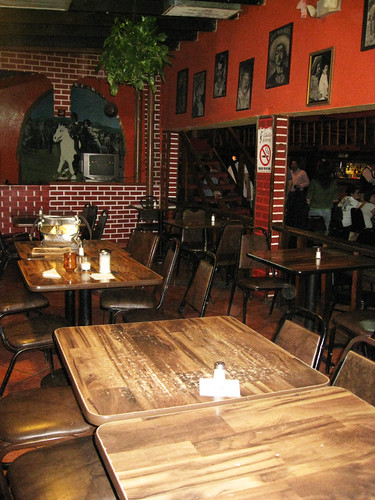
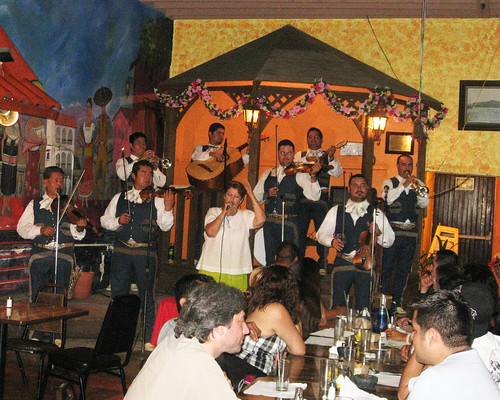
Hopefully, you enjoyed learning more about this Mexican musical tradition so now, let's get back to La Vuelta. When we arrived at La Vuelta and made our way into their larger dining area, we were greeted by the sounds of a mariachi band, performing on a gazebo-like stage.

Baja Food and Wine Culinary Tour - Day 1:  Tijuana

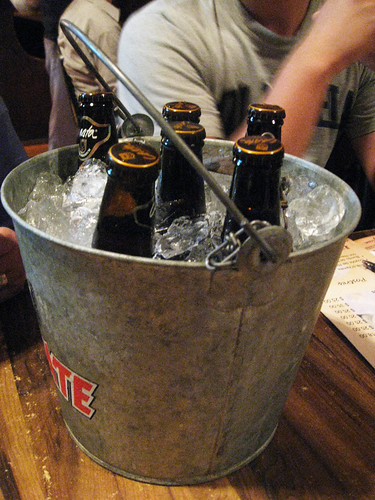
Once seated, the restaurant sent over complimentary tortilla chips and salsa and beef taquitos along with our choice of beers. The majority of us opted for the Casta beer and while we nibbled and sipped, we sat back and enjoyed the performance.

Baja Food and Wine Culinary Tour - Day 1:  Tijuana

Baja Food and Wine Culinary Tour - Day 1:  Tijuana

The food at La Vuelta was solid, if not spectacular, but in the end, it's not really about the food. It's more about finding a late night spot becaue you're still not quite ready to turn in yet. A few appetizers, a beer or two or more and enjoying the lively music and singing of a mariachi band is certainly not a bad way to end your night.

Baja Food and Wine Culinary Tour - Day 1:  Tijuana

By the time we left La Vuelta, it was around 1:30 am. I was definitely ready for a good night's sleep for tomorrow was going to be an early start time where the first activity of the day was going to be a Tijuana City Tour. More to follow.


La Vuelta
Ave, Revolucion y Calle 1, #2004
Centro
Tijuana, Mexico
www.restaurantlavuelta.com

Click Here to See the Photos of the Entire Trip!

¡Baja Delicioso!
- Introduction and the Ultimate Carne Asada Taco at Tacos El Poblano
- The History of Mariachi and Late Night Mariachi at La Vuelta

 - TJ City Tour, Cuban Cigars, Chili Shrimp Tacos and Churros
- From Spain to Argentina to My First Taste of Baja Med Cuisine

Disclaimer: Sponsored by the Tijuana Visitors and Convention Bureau along with the support of the Crossborder Business Associates, Cotuco (Tijuana Tourism Board) and the Tijuana Canirac (Tijuana Restaurant Association). This sponsorship took the form of these organizations paying for our travel arrangements, our hotel accomodations and all our meals.


^

Wednesday, October 28, 2009

Introductory Street Food at Street Restaurant

Dinner at Street

Having done my share of ethnic and street food dining over the years, I was definitely curious as to what the food was going to be like at Street Restaurant. Inspired and created by Susan Feniger of Two Hot Tamales fame and also part-owner of LA's Ciudad and Border Grill, the focus of this new endeavor was geared towards a menu that was globally street-food and snack-food inspired.

More ...

Dinner at Street

While I was intrigued by the idea of Street restaurant, I'm sure it wasn't meant to replace the true street food experience. When it comes to street food, there's just something about being so close to the preparation of your food that you can practically lend a helping hand. Second, there's a certain camaraderie with other people, as you wait on the sidewalk in anticipation of your food being served. Third, I just love the get your hands dirty aspect of eating from a paper plate or tray. Finally, I really enjoy how simply the food is prepared. These street chefs cook their food without any fuss or muss and of course, you can't beat the price.

Dinner at Street

I think what Street restaurant does well is give its customers an introduction to ethnic street food and snacks, but in such a way where they can sit comfortably at table and chair with china and silverware in a funky and cool setting. Plus, they don't need to globe trot the world or even all over Los Angeles to taste the world's flavors. A good portion of it can be seen on the menu. So given all that, what did I think about the food? To start, I enjoyed the appetizer which were Millet Seed Puffs with Marshmallow, Fennel, Curry, Coriander,Cumin and Black Currant. I enjoyed the light crunchiness of this dish and it was a welcome change from the standard bread and butter.

Dinner at Street

For my beverage of choice, I went with the Cantaloupe and Beet Agua Fresca, which was beautifully presented. The intense red of the beet was layered over the intense orange of the cantaloupe juice. Pretty to look at, but also very refreshing.

Dinner at Street

Soon our dishes started arriving with the first to our table being the Paani Puri, which were small bites of spiced potato, chutneys and sprouted beans enclosed in crispy puffs of dough, topped with yogurt. For an added dimension, you pour cilantro water into the puff. I've had a similar dish called the Danipuri at a restaurant called Rasraj, so I knew the intent was to eat the Paani Puri in one bite. Was it a good bite? It was good enough. Having done my share of eating Indian food, I would have liked there to be more of a kick in flavor as well as a cilantro water that was less watered down, but overall, it was a promising start to our meal.

Dinner at Street

Along with the Paani Puri came the Spinach Varenyky, which were small Ukranian dumplings filled with spinach and a light layer of salted cheese, boiled than pan-fried sour cream, fried onions and lemon marmalade. Being a spinach lover, I was already pre-disposed to loving this dumpling with my first bite, but unfortunately, it didn't do much for me. I did enjoy the spinach itself, but the other flavors seemed too muted for my taste.

Dinner at Street

The next dish that arrived was one of my favorites and what's interesting is that it could easily be replicated at home. Simply, the Kaya Toast was sheer perfection and it's comprised of toasted bread spread thick with coconut jam and served with a soft boiled egg drizzled in dark soy sauce and white pepper. Be sure to dip the bread into the broken yolk for both sweet and savory flavors.

Dinner at Street

Following the Kaya Toast, came the Japanese Shizo Shrimp, which were deep fried marinated shrimps that were rolled with shizo and nori seaweed and came with a dipping sauce of ponzu, grated radish and wasabi as well as the Moldavian Meatballs, ground beef and kasha meatballs simmered in a sweet and sour tomato sauce with dill sour cream. While neither were show stoppers, they were solid dishes with the shrimp being light and crispy and the meatballs cooked in a sauce that I wouldn't mind pouring on top of noodles and enjoying in that manner.

Dinner at Street
Dinner at Street

My second favorite dish of the meal was the Malaysian Black Pepper Clams, which had clams simmered in oyster sauce with cracked black pepper, palm sugar, soy and lime. That broth was heavenly. Forget the clams. I was happy just dipping the bread into the bowl, soaking up the broth and biting into the bread. We even asked for more bread because we didn't want the broth to go to waste. It was that good.

Dinner at Street

More Indian flavors came our way with the arrival of the Saag Paneer, Kokum Dal and Rice Plate, a South Indian spinach dish stewed with homemade paneer cheese, tomato and spices, served with dried plum dal and yogurt rice as well as the Indian Semolina Cakes, which were crispy pan fried cakes of utma semolina with toasted cashews, peas, tomato and spices, topped with tomato chutney. The Saag Paneer dish wasn't that memorable, but I did enjoy the semolina cakes, although I would have liked them to be a bit more airy and not as heavy in texture.

Dinner at Street
Dinner at Street

Our last savory dish before dessert was the Massamum Chicken Curry, a Southern Thai curry dish with chicken, red yam and mushrooms simmered in coconut milk and spices. I just had a little taste of the curry, but having been spoiled by eating at Jitlada, a Southern Thai restaurant, I would have liked a little more complexity and a lot more heat in the curry sauce itself. To be fair though, I only had a couple of spoonfuls so if the heat was more of a slow burn, I wouldn't have noticed from such a limited sampling.

Dinner at Street

There's always room for dessert and my party went for the Turkish Doughnuts, small spiced pastries, fried and simmered in cardamom rose syrup served with sour cream and rose hip jam and a Toffee and Cookie Plate which included peanut and butter jelly cookies and bittersweet chocolate toffee. I liked the doughnuts, although from the look of them, they seem like they were over-fried? As for the Toffee and Cookie Plate, nothing really exciting, but it served its purpose of giving us something sweet to end the meal with.

Dinner at Street
Dinner at Street

Overall, although the food was hit and miss for me, I like the idea of Street, in that it could introduce new foods to customers who aren't usually that adventurous and hopefully, it will encourage them to also seek out more authentic flavors elsewhere. As for me, Street isn't in my near future, but at least my time there was a nice little jaunt around the world and all from one table.

Click here to see all the photos!

Street
742 N. Highland Ave
Los Angeles, CA 90038
(323) 203-0500
www.eatatstreet.com


Susan Feniger's Street on Urbanspoon

^

Sunday, October 25, 2009

Heritage Square Museum 40th Anniversary Fundraiser

Heritage Square Museum

Heritage Square Museum -
40 Years of Preservation Celebrated at the Historic San Antonio Winery

On Saturday, November 7, the Heritage Square Museum will host a very special 40th Anniversary Fundraiser and Luncheon at the historic San Antonio Winery. This event will help raise critical funds for Heritage Square Museum to continue for another 40 years. The Fundraiser begins at 1:30 p.m. and ends at 4:30 p.m. Honorary Event Chair, Councilman Ed Reyes, District One, will be in attendance and making a special presentation.

Tours of the San Antonio Winery and wine tasting reception are from 1:30 to 2:30 p.m., with the luncheon buffet beginning at 2:30 p.m. Special celebrity guest appearances soon to be announced.

More About the Heritage Square Museum:

In 1969, Heritage Square Museum began its mission to preserve the history of Southern California and eventually saved eight historic structures. Forty years later, it is one of the leading living history museums in Southern California, dedicated to telling the story of the development of Los Angeles.

Heritage Square Museum has seen remarkable growth in 2009. With an aggressive slate of exciting programs, events and exhibits, museum attendance has already surpassed all of 2007 and will exceed 2008s total before the year is over. In 2010, the museum is planning its greatest period of expansion in decades. A new drugstore (complete with original furnishings), the recreation of historic windows on the Lincoln Avenue Methodist Church, an expansion of the Victorian Fence Project, important infrastructure improvements and more are planned to meet the museum’s growing needs make for more exciting opportunities for all of its International, National and Southern California visitors.

Heritage Square Museum is regularly open Fridays, Saturdays and Sundays, from 12 to 5 p.m. (Hours vary November to February). Admission is $10/adults, $8/seniors, $5/children ages 6-12. The Museum is located at 3800 Homer Street, off the 110 Arroyo Seco Parkway (110/Pasadena Freeway) at Avenue 43, just north of downtown Los Angeles. For further information, visit our website at www.heritagesquare.org.

Heritage Square Museum 40th Anniversary Fundraiser
Saturday, November 7, 2009 from 1:30 pm - 4:30 pm
San Antonio Winery
737 Lamar Street
Los Angeles, CA 90031
Tickets are $125.00

Tickets can be purchased by calling the Heritage Square Museum at (323) 225-2700